
When the Horizons Collapse
Resistance, Crisis, and the Deep Attractors of Tomorrow


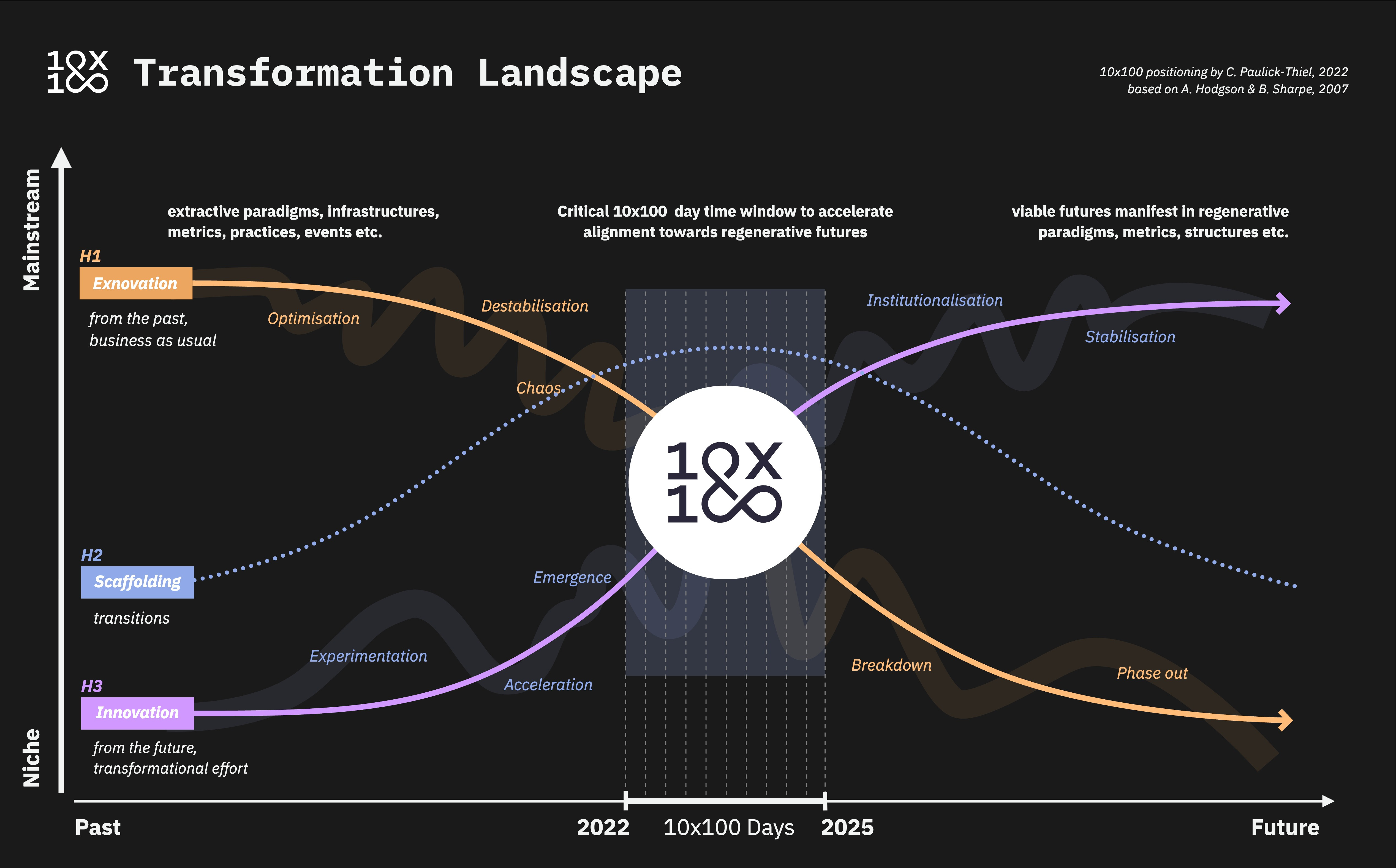
For several decades, strategic thinking about systemic change has often been organised through the language of the Three Horizons. The framework emerged as a way of understanding how transformation unfolds across time: the present system that structures everyday life, the transitional innovations that begin to reshape it, and the deeper paradigms that ultimately redefine the foundations of society.
Within this framework, Horizon 1 refers to the dominant institutions, infrastructures, and economic arrangements that organise the present. Horizon 2 describes the transitional terrain in which new models begin to emerge, often through hybrid forms that combine elements of the existing system with unfamiliar organising principles. Horizon 3 points toward more fundamental transformations — new civilisational logics, institutional architectures, and technological capacities that reshape the underlying conditions of human organisation.
Implicit within this framework has always been an assumption about time. Horizon 3 developments were generally expected to unfold over long horizons, often spanning a decade or more before they began to materially reshape economic and institutional reality. That temporal distance allowed societies to experiment, debate, and gradually metabolise the implications of structural change. Governments could deliberate, markets could adapt, and institutions could absorb the tensions associated with transformation without being overwhelmed by them.
Increasingly, however, that temporal spacing is collapsing.
Technological acceleration, ecological instability, geopolitical competition, and the extraordinary speed with which capital, knowledge, and organisational capacity now circulate through the global system are compressing what were once long arcs of change into far shorter cycles. Developments that might previously have unfolded over twenty years now emerge within the same three-to-five-year window in which institutions are expected to manage the present. Structural shifts that once appeared as distant futures now intrude directly into contemporary decision-making.
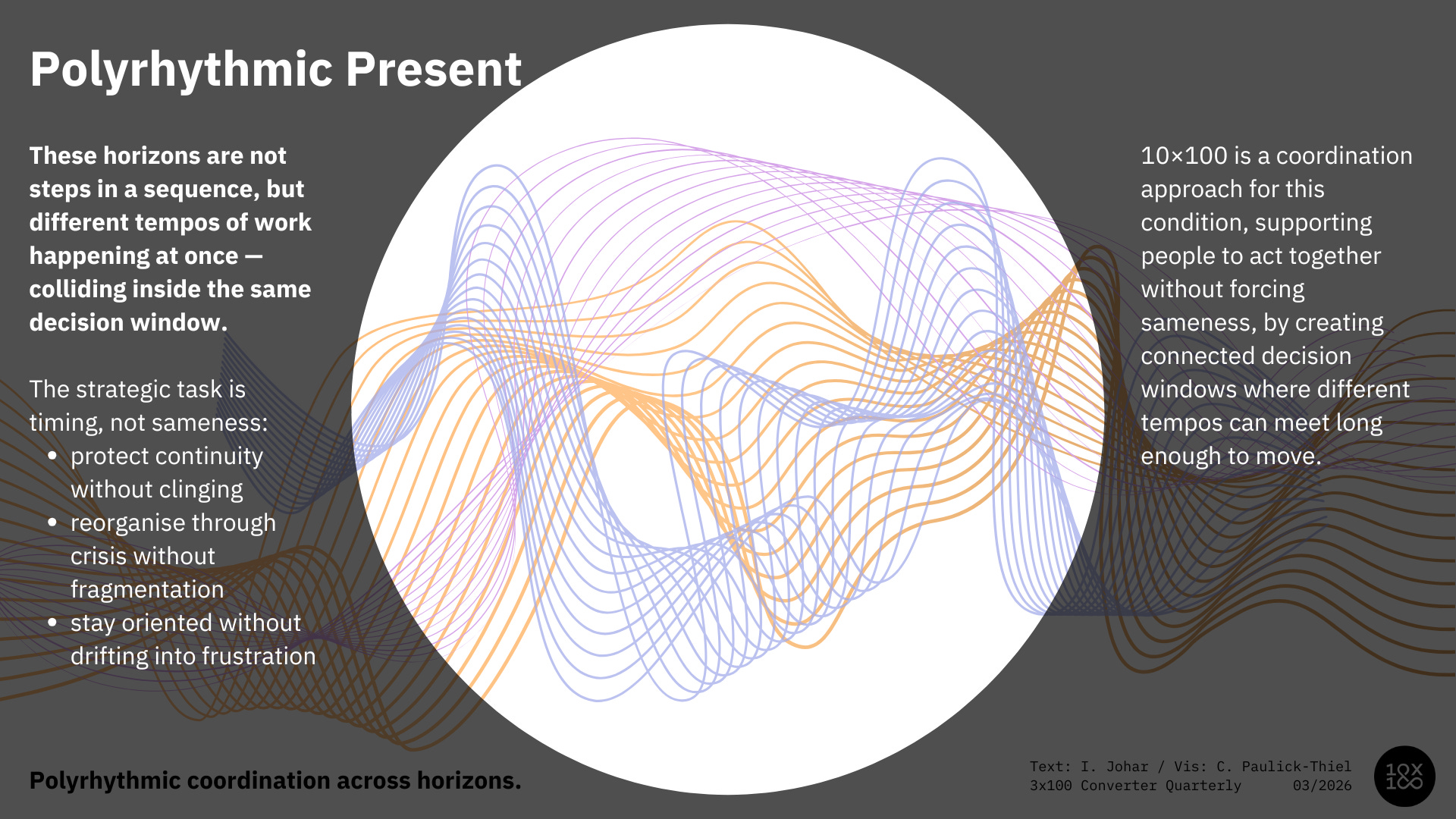
This compression does not simply mean that change is happening faster. Rather, it means that multiple layers of transformation are arriving within the same operative window. Stabilisation, transition, and civilisational redesign — processes that were once partially separable across time — increasingly collide within the same political, economic, and institutional moment.
Under these conditions, the Three Horizons are no longer best understood as sequential stages through which societies gradually move. Instead, they describe three distinct strategic functions that must now operate simultaneously within the same historical landscape.
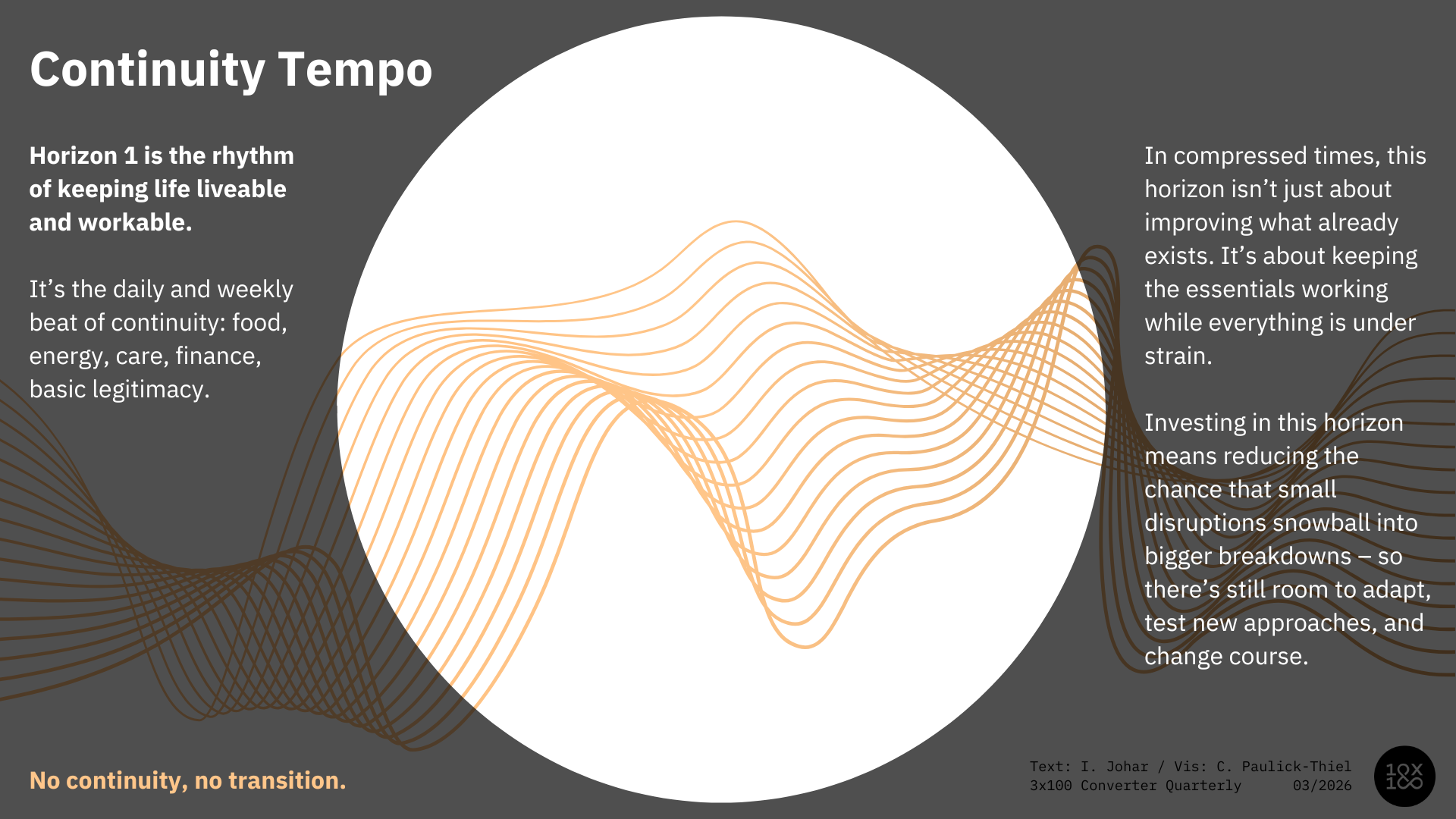
Horizon 1: Resistance and the Protection of Continuity
In periods of relative stability, Horizon 1 is commonly associated with optimisation. Institutions focus on improving efficiency, refining governance structures, and strengthening the systems that sustain everyday life. The dominant system is taken as the starting point, and the primary task becomes one of incremental improvement.
In an era defined by escalating systemic volatility, however, the character of Horizon 1 changes in a more fundamental way. The central function of this horizon becomes resistance.
This resistance should not be confused with the defence of the status quo for its own sake. Rather, it reflects the recognition that societies must maintain certain continuity conditions if they are to retain the capacity to transform themselves at all. Energy systems must continue to function. Food systems must remain reliable. Financial coordination must remain operational. Basic governance must maintain enough legitimacy and coherence to organise collective action.
When these foundational conditions destabilise too rapidly, the possibility of transition collapses with them. Societies that lose the ability to maintain continuity often lose the space required for experimentation and structural adaptation. What follows is not transformation but fragmentation.
The work of Horizon 1 is therefore best understood as the protection of continuity conditions against destabilisation severe enough to foreclose transition. It involves buffering shocks, maintaining essential infrastructures, preserving social coordination, and slowing cascading breakdowns long enough for deeper systemic reorganisation to emerge.
In this sense, resistance is not the opposite of change. It is frequently the precondition that makes meaningful change possible. Without the stabilising work of Horizon 1, the space within which new systems might form disappears.
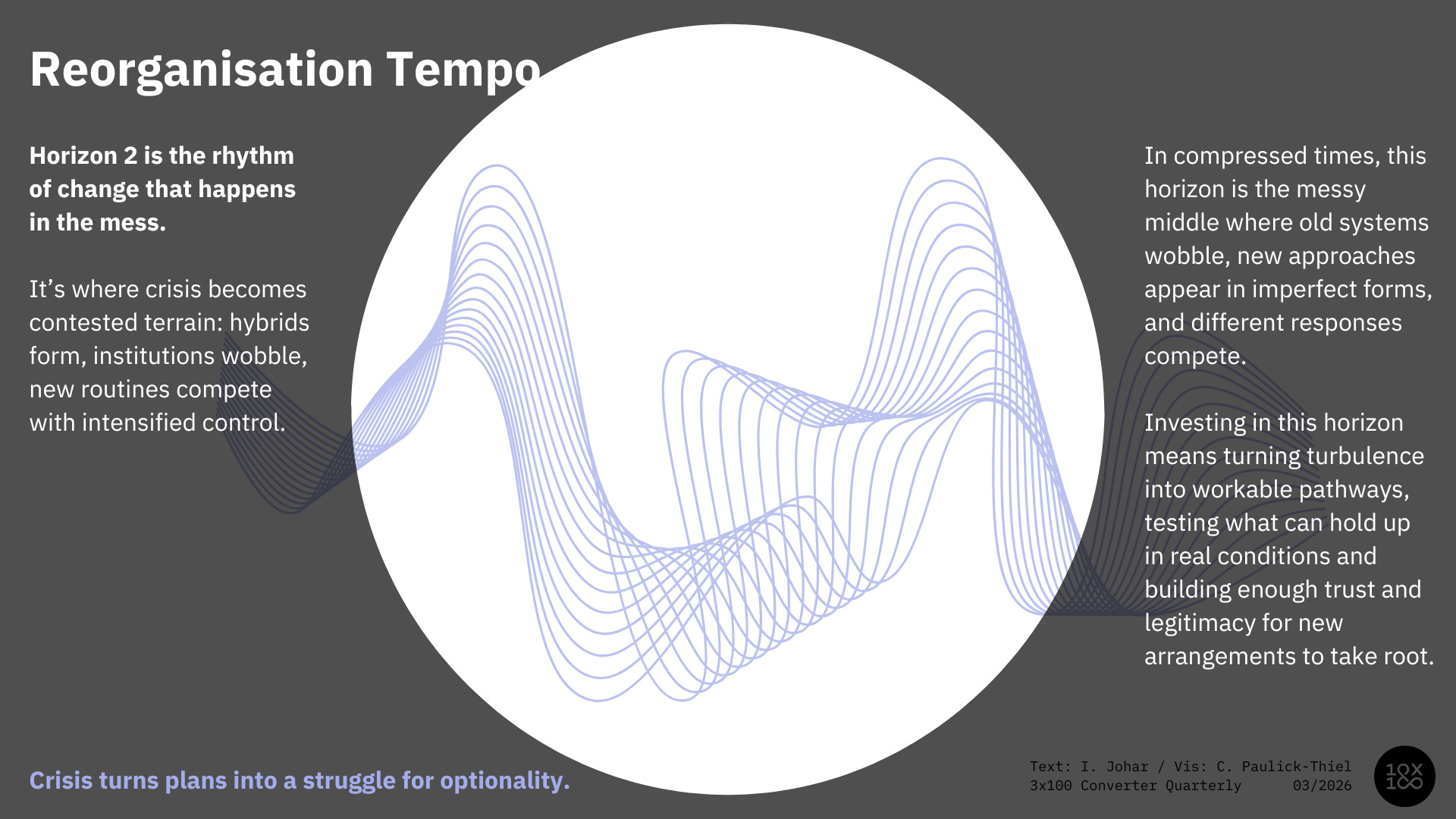
Horizon 2: Crisis as the Terrain of Reorganisation
Where Horizon 1 seeks to preserve continuity, Horizon 2 operates within the turbulence that emerges when existing systems begin to lose coherence. It is the domain in which crisis becomes the terrain upon which competing futures struggle to take shape.
Periods of systemic strain rarely produce orderly transitions. They generate uncertainty, fragmentation, and contestation. Established institutions begin to falter or lose legitimacy while new possibilities emerge in partial and experimental forms. Early transitional systems are rarely coherent or stable. They often appear as hybrid arrangements that combine fragments of the old order with emerging principles of organisation.
Historically, many of the most consequential institutional innovations have emerged under precisely these conditions. Moments of crisis reveal the structural limitations of prevailing systems while simultaneously creating openings through which alternative arrangements can begin to form.
Yet crisis itself is not inherently generative. The destabilisation of existing systems can just as easily produce fragmentation, securitisation, and authoritarian consolidation as it can produce renewal. The transitional terrain of Horizon 2 is therefore not simply a space of creativity. It is a political and institutional struggle over the terms of systemic reorganisation.
Within this contested space, competing pathways attempt to shape the direction of change. Some responses seek to stabilise the existing order through intensified control. Others attempt to construct new infrastructures, governance models, and economic arrangements capable of addressing the structural limitations that crisis has exposed.
Horizon 2 can therefore be understood as the effort to metabolise crisis into transition. It is the domain in which societies attempt to convert destabilisation into the foundations of a new systemic configuration.
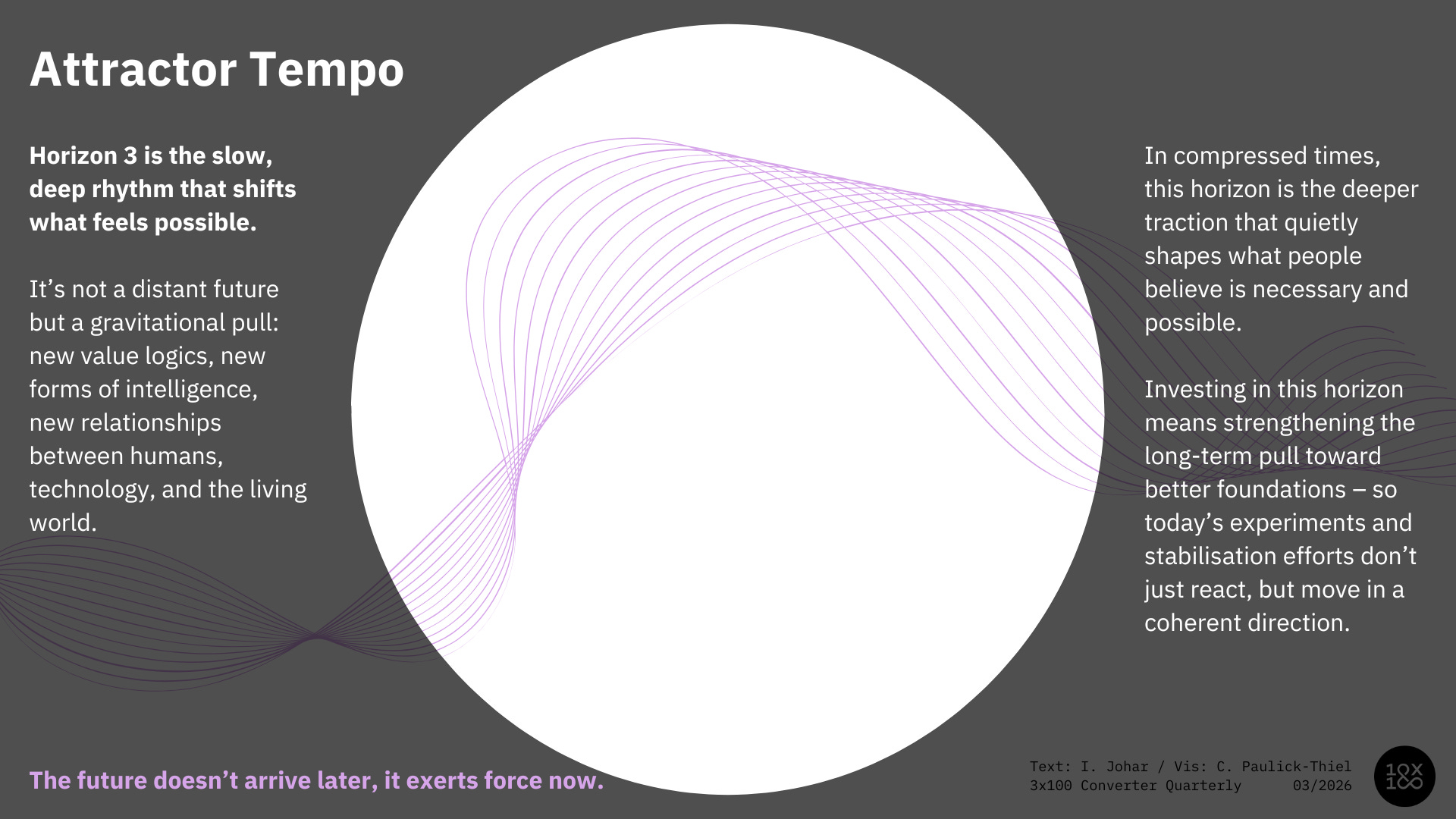
Horizon 3: The Deep Attractors of Civilisational Change
Beyond the turbulence of transition lies the deeper territory of Horizon 3. While Horizons 1 and 2 operate largely within the dynamics of existing systems and their immediate transformations, Horizon 3 concerns the deep attractors that shape the long-term trajectory of civilisation itself.
These attractors rarely first appear as concrete institutions or policies. Instead, they begin as shifts in the underlying coordinates through which societies organise themselves. They involve transformations in how value is understood, how intelligence is distributed, how governance systems coordinate collective action, and how humanity understands its relationship with technological systems and the broader planetary environment.
Questions about the evolving relationship between humans and increasingly capable machines, the redesign of economic systems beyond extractive value logics, the emergence of planetary-scale governance structures, and the development of new forms of collective intelligence all belong within this domain.
Initially these developments often appear speculative or philosophical. They may emerge as experimental technologies, institutional prototypes, or cultural narratives that challenge prevailing assumptions about how societies should function. Yet over time they begin to exert a subtle but powerful influence on the direction of innovation, investment, and political imagination.
In this sense, Horizon 3 operates less as a set of concrete proposals and more as a gravitational field shaping the landscape of possibility. It establishes the deeper orientation toward which societies may gradually evolve.
Crucially, these attractors are not purely speculative futures. They are already exerting influence on the present, reshaping expectations about what forms of coordination, governance, and value may ultimately become viable.
When the Horizons Collide
The compression of the horizons fundamentally alters the strategic environment within which societies must operate. In earlier historical periods, it was possible to move gradually from one horizon to the next. Stabilisation would precede transition, and transition would eventually give way to the emergence of new paradigms.
Today that sequence is increasingly difficult to sustain.
Societies must stabilise critical infrastructures even as those infrastructures undergo structural transformation. They must experiment with transitional models in the midst of geopolitical instability and ecological disruption. At the same time, they must grapple with deeper civilisational questions about technological agency, governance, and the nature of human contribution.
Resistance, transition, and reimagination therefore cease to be sequential phases of development. They become simultaneous responsibilities that unfold within the same historical moment.
This simultaneity places unprecedented demands on institutions. Governance systems designed for incremental reform must now stabilise the present while enabling systemic redesign. Economic systems must continue to provide essential goods even as their underlying logic is questioned. Political systems must maintain legitimacy while navigating the profound uncertainty associated with structural transformation.
The result is often fragmentation: defensive stabilisation in one domain, experimental transition in another, and speculative futures thinking disconnected from operational reality.
The Risks of Losing a Horizon
Understanding the Three Horizons as concurrent functions also reveals the risks that arise when one horizon dominates the others.
When Horizon 1 dominates without the presence of Horizon 2 or Horizon 3, resistance hardens into stagnation. Institutions devote themselves to defending systems that are already losing viability, producing brittle forms of stability that eventually fracture under pressure.
When Horizon 2 operates without the stabilising work of Horizon 1, transition becomes chaotic. Systems destabilise faster than new arrangements can form, resulting in fragmentation rather than renewal.
When Horizon 3 dominates without grounding in the realities of the present, future thinking detaches from operational capability. Societies become rich in visionary narratives but poor in the institutional capacity required to translate those visions into practice.
The challenge of the present moment is therefore not to prioritise one horizon over the others but to hold them in dynamic balance.
Acting Within the Compression
The compression of the horizons creates a new kind of strategic challenge. Many of the institutions that govern modern societies were designed for a slower world — one in which structural transformation unfolded gradually and where policy cycles, investment frameworks, and institutional learning processes could adapt over time.
In the emerging landscape, such assumptions are increasingly untenable.
The central task is no longer simply to optimise the existing system, nor to accelerate disruption blindly, nor to speculate about distant futures detached from present realities. Instead, societies must learn how to operate across these compressed horizons simultaneously: stabilising the conditions of the present, metabolising crisis into transitional pathways, and orienting action toward deeper civilisational attractors.
The Three Horizons framework therefore remains valuable, but only if it is reinterpreted for this compressed era. The horizons are no longer distant stages along a timeline. They are simultaneous dimensions of the present, each representing a distinct form of work that must now occur at the same time.
To act effectively in such conditions requires an unusual institutional capacity: the ability to preserve stability without clinging to the past, to embrace crisis without allowing it to become destructive, and to imagine the long-term future while remaining deeply grounded in the practical realities of the present.
This piece was crystallized by Indy Johar thanks to the 10x100 Quarterly exchange with including Ralph Thurm, Paul Jerchel and the Converter cohort
 | A guest post by
|
Thanks a lot for your thoughtful responses!
We took the critique seriously and worked to refine the language, sharpen the assumptions, and translate the thread into a more practical follow-up: https://10x100.substack.com/p/from-chaos-to-cadence
Let us know if that resonates or propose a better way to approach it.
It's safe to say that frameworks are now devoid of utility. Building clarity about what is worth aspiring towards even if, for all practical purposes, there isn't a means to realize those aspirations, is what matters.
We are part of a evolutionary flow. The semblance of control or casual determinism was likely a fleeting correlation.
When we realize that most of the communally aligning elements were prescribed by institutions that sought to control and extract by colonial powers, accelerationalism and anarchy feels like the right medicine. Stability always gets coopted by bad actors.