

The European Forum Alpbach 2026 asked how Europe wins as geopolitical, ecological, technological and economic pressures intensify. In our earlier reflection, The Present Is Not a Race, we placed this question within a wider reality: Europe’s capacity to act is produced through interdependence.
Energy, materials, ecosystems, technologies, finance, law, labour and knowledge connect Europe to conditions far beyond its borders. European decisions reshape those conditions and return through the same relationships. Speed, scale and relative advantage may strengthen particular capabilities. Their wider value depends on what they secure, whose agency they expand and which future conditions they preserve.
One possible European contribution lies in organising across difference: creating reciprocal stability, sustaining plural forms of agency and keeping coordination open to evidence, contestation and correction. This measures power partly by whether its use expands or contracts the conditions for others to act.
The Forum’s conversations gave this question urgency as pressures interact. Since 2022, 10x100 highlighted that disturbances travel through shared dependencies and feedback loops; responses in one domain alter conditions elsewhere. Effects emerge across places and timescales, often beyond the reach of those carrying the greatest exposure. This is the terrain of interconnected risk.
Under these conditions, becoming capable together is a political project. Networks can circulate knowledge, resources and care; they can also accelerate extraction, exclusion and control. The politics lies in what a field becomes capable of, who gains agency, who absorbs risk and which future possibilities remain open.
Within this wider Forum landscape, the 10x100 Converter Lab asked:
How can people working from different positions and theories of change combine their capacities without collapsing their differences? And how can their coordination expand shared agency while conditions remain in motion?
Politics for Tomorrow and Dark Matter Labs convened the Lab under the invitation From Circles to Fields: Organising Regenerative Capacity Under Pressure. The Converter Cohort brought together practitioners working across public institutions, finance, civil society, technology, ecology and place.
Participants mapped their approaches, examined live work, exchanged emerging systems functions and developed small forms of infrastructure for testing. BRAID added a machine-assisted reading of selected conversations, surfacing agreements, dependencies, tensions and non-translations.
What follows is a first interpretation, offered for correction and further testing. Its working proposition is that every theory of change is partial. A field becomes more capable when different approaches can expose one another’s limits, supply missing capacities and remain in feedback as consequences emerge. Its political value depends on whether this strengthens legitimate agency, material security and the capacity to change course.
When successful action has wider effects
Projects make action possible by defining a problem, mandate, resources and criteria for success. These boundaries can also leave consequential relationships outside the frame.
One group explored this through a participant’s account of conservation measures in Zimbabwe. Efforts to reduce elephant poaching achieved their stated purpose. Changes in protected populations also created pressures for people, habitats and other species. The example served as an illustration rather than a complete assessment. It raised a difficult question: how should success be understood when an intervention reaches its objective while changing relationships its original framing barely perceived?
The group considered “do no harm” and encountered a further difficulty. Harm requires interpretation. Protection involves choices, and delaying action changes what remains exposed.
The discussion suggested that the quality of an intervention depends on its intention and results, as well as its capacity to perceive wider effects, receive challenge and change course. Complexity raises the standard for action; urgency increases the need for judgement. Consequential action requires direction and corrigibility: enough commitment to matter and enough openness to be changed by what the action sets in motion.
What became visible between different approaches
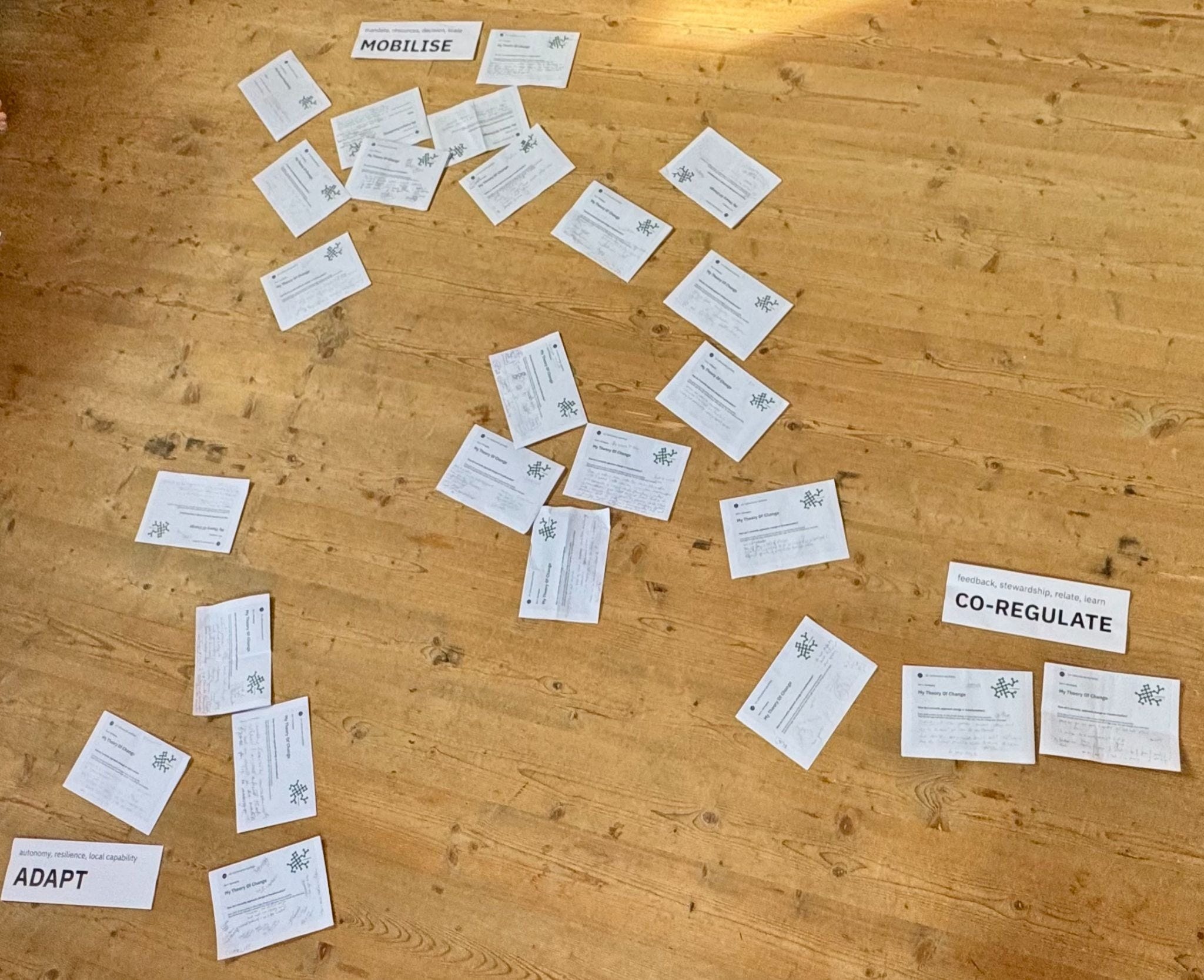
Participants positioned themselves in relation to mobilisation, adaptation and co-regulation, then moved as their understanding developed. Mobilisation gathered work concerned with direction, political openings and concentrated resources. Adaptation emphasised continuity, resilience and situated response. Co-regulation focused on relationships, feedback and learning. Many participants stood between these orientations.
The value lay less in the labels than in what became visible between them. Mobilisation can create momentum while narrowing perception around an objective. Adaptation can sustain essential activity while underlying conditions deteriorate. Co-regulation can preserve learning and relationships while struggling to create direction when time contracts or powerful actors refuse cooperation.
The emerging insight concerned composition. Interconnected risk may require mobilisation around an urgent decision, adaptation across places and co-regulation to register consequences and revise implementation. Different approaches can lead at different moments.
The Lab described this as a more mature mode: recognising the partiality of one’s own framing, drawing on other capacities and remaining open to correction. It resembles a living portfolio of change logics rather than a shared doctrine. Such a portfolio still carries risks. Diversity can diffuse responsibility, dialogue can delay necessary decisions and a strong mission can absorb every other concern into its own terms. Composition creates capacity when approaches genuinely affect one another and responsibility remains clear.
From circles to fields
The next inquiry examined how capacity is carried. In triads, participants considered themselves as functions within larger systems and asked:
What should concentrate?
What should distribute?
What must remain in feedback?
The conversations surfaced knowledge held by individuals, prototypes nearing readiness, translation work between sectors, weak routes from insight to funding and coordination sustained through informal goodwill. Considerable capacity was present, yet much of it remained difficult to locate, activate or sustain.
This distinction matters. Connectivity describes who can reach whom. Capacity describes what those relationships can carry: a request, warning, difficult decision, resource flow or commitment over time.
Circles create depth through trust, shared language and sustained attention. A field begins to form when distinct circles become sufficiently legible and useful to one another for knowledge, resources, judgement and learning to move between them. Smaller constellations can then form around specific situations, keeping responsibility close to the work while drawing on wider capabilities.
When connection becomes capacity
The survey and Lab conversations converged around six emerging functions:
recognition of people, knowledge, active work, offers and needs;
routing of resources, legitimacy and opportunity towards work ready to move;
case clinics that turn situated problems into shared intelligence;
translation across professional languages, institutional logics and publics;
collective memory, feedback and correction;
forms of commitment, care and organisation suited to volatility.
Participants selected a function they wanted to use, developed a small version for their own work and invited others to test it. Several required assets already existed. A request for recurring peer support met a case-clinic format ready to pilot. A need for a human library met an existing mapping platform and knowledge space. A proposed funding function encountered a database already in development.
The gap often lay between assets. The practical challenge was conversion: making existing capacity available when it could alter a real situation.
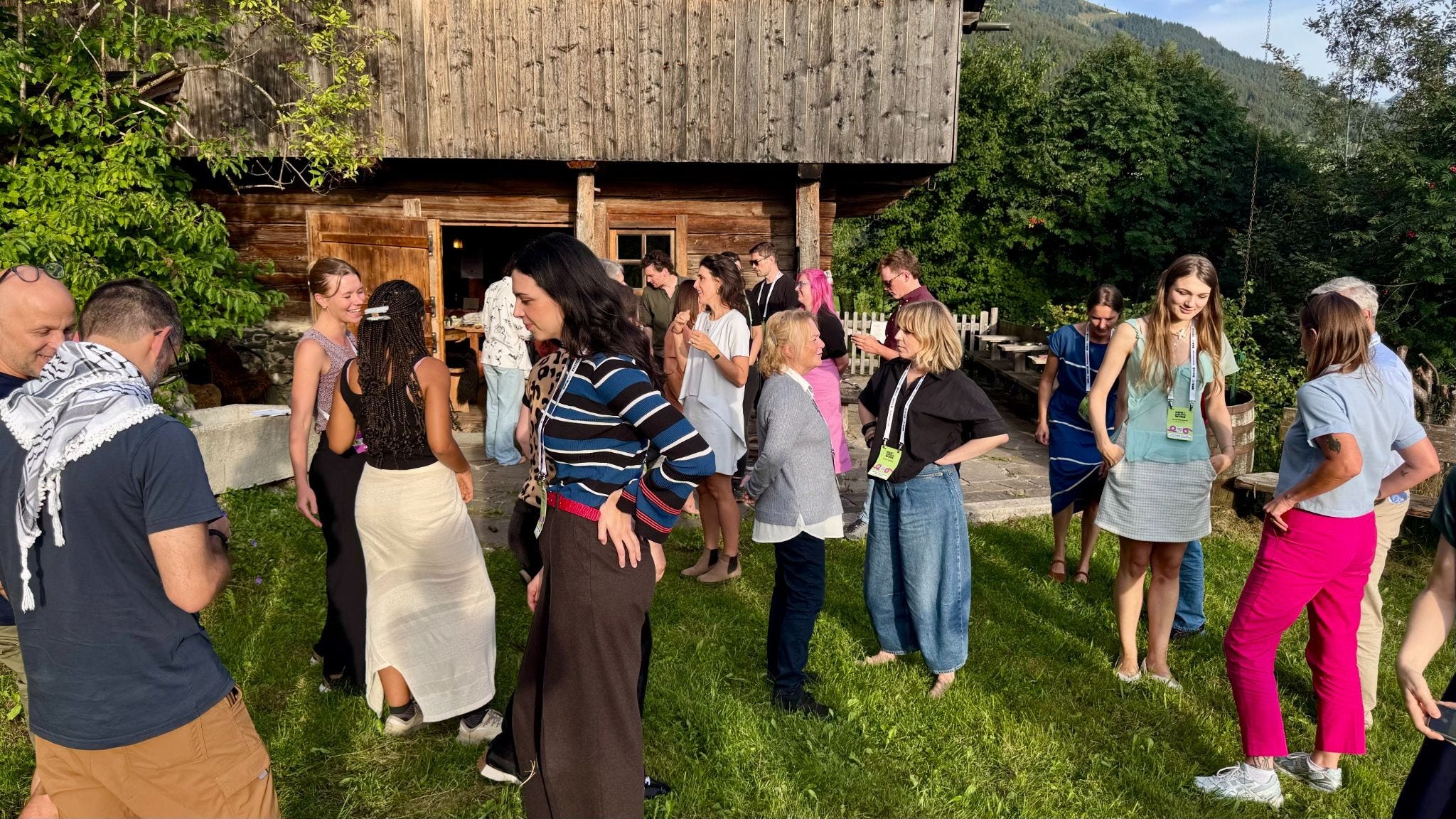
One exercise made these dependencies tangible. Six participants represented the functions before learning their labels. A seventh entered the constellation carrying pressures named in the room: disruption, uncertainty, grief, urgency and the declining reliability of established arrangements.
Funding without field intelligence can favour what is already legible. Narrative without authority or resources creates recognition with limited agency. Learning infrastructure without live cases becomes storage. Case support without trust remains superficial.
One participant described the resulting constellation as a planetary system without a sun: coherence arose through mutual support, reflection and movement rather than a single centre.
Distribution, however, does not remove power. Decisions may require temporary concentration; situated knowledge and initiative may benefit from distribution; consequences need to remain in feedback. Related questions therefore apply to the field as a whole.
Reading patterns while preserving difference
BRAID, developed by komma.systems and nextlearning.earth, supported a machine-assisted reading of selected Lab conversations. Recording was optional and raised questions about consent, data control, environmental cost and the role of AI in a trusted setting.
With consent, conversations were transcribed and compared. BRAID distinguished where statements corresponded, remained in tension, depended on one another, evolved or used similar words for different realities. These non-translations proved especially useful. “Local” referred both to renewed in-person action and to formal authority at neighbourhood scale. “Legitimacy” meant trust earned through visible conduct and authority redistributed through institutional design. “Scale” described centrally supported expansion and peer-to-peer multiplication. The state appeared as both a captured mechanism to work around and an infrastructure to reclaim.
A smooth synthesis could have reported agreement around localism, legitimacy, scale or public capacity. BRAID helped retain the political distinctions inside those terms.
Machine-assisted reading extends the range of comparison. AI has no lived experience, embodiment, intuition or personal accountability. It processes a record shaped by what was captured and made legible. Participants bring situated judgement and embodied perception, alongside limits of attention and memory.
The value lies in combining these capacities carefully. Machine analysis can widen comparison; participants retain authority to recognise, contest, correct or refuse what it returns. This creates another feedback path through which a field can perceive patterns while preserving difference.
Relational security under pressure
Material assets, institutions and critical infrastructures remain essential. Their effectiveness also depends on relationships through which signals, judgement, resources and responsibility can move.
Relational security describes the capacity of differently positioned actors to exchange relevant information, mobilise support, contest assumptions and revise decisions under pressure. It includes trust and care alongside boundaries, dissent, and routes for escalation. It matters when conditions change faster than any single actor can interpret them and effective action depends on capabilities held elsewhere.
This proposition needs critical tests. A curated field can become enclosed. Shared language can conceal incompatible interests. Relational practice can leave concentrated power untouched. Distribution can blur responsibility. Coordination can generate additional invisible labour. AI-supported synthesis can manufacture coherence.
Relational security therefore has to be assessed through material consequences:
Can a warning change the work?
Can resources and decision rights move?
Can disagreement remain visible while cooperation continues?
Is responsibility clear?
Does coordination reduce burdens carried alone and preserve capacity for future action?
These questions connect relationships to agency. They also position 10x100 within the Forum’s concern with Europe’s capacity to act. Large-scale ambition depends on policy direction, finance and technological capability, as well as the ability of actors across institutions, sectors and places to perceive together, coordinate across difference and revise action as effects emerge.

From updates to offers
The Lab closed with invitations to pilot a case clinic, test forms of a human library, open an existing funding tool for feedback, develop narrative translation and connect learning across these activities. A further inquiry began around organisational forms capable of sustaining agency and care amid volatility.
Their significance will depend on use. A field becomes tangible when its functions change who can act, with whom, on what and with which resources.
The Converter Lab developed the position of The Present Is Not a Race. Under interconnected risk, collective capability depends on speed and scale, and on whether different ways of acting can expose one another’s blind spots and change as their effects become visible.
Europe’s systemic contribution may lie here: organising plurality without turning every relationship into a contest for control; connecting situated action with shared infrastructure; and treating feedback and course correction as expressions of agency.
The Lab’s contribution is modest and consequential. Good intentions can provide direction; relational capacity helps that direction remain accountable to a changing world.
Can our work remain open to being changed by the world it changes? And can the relationships around it help us act differently when that becomes necessary?
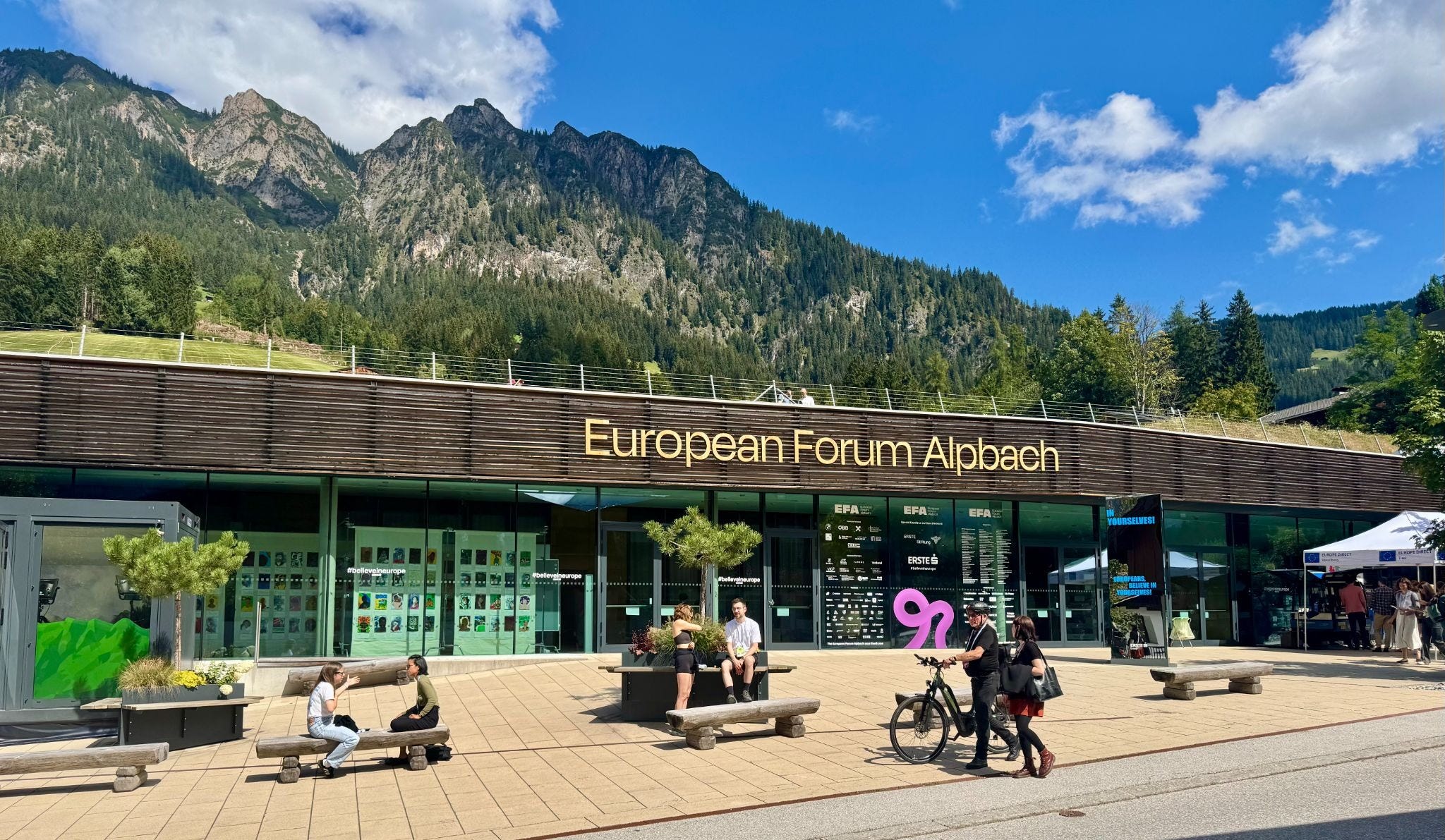
In gratitude to everyone who took part in the 10x100 Converter Lab, and to the colleagues, partners and supporters who made the gathering at the European Form Alpbach and the journey towards it possible.
Thank you for bringing your experience, difficult questions and willingness to learn with one another!